 ENG
ENG
 INA
INA
The Undergraduate Civil Engineering Study Program, Faculty of Engineering, Udayana University, Holds the 2026 National Seminar on Civil Engineering
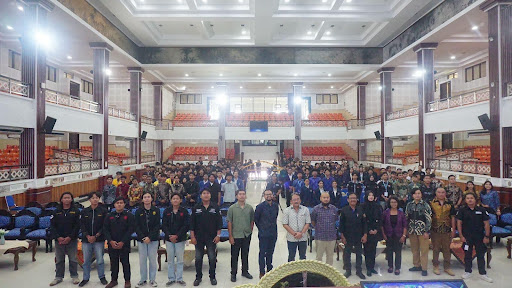
To enhance participants’ knowledge, insights, and competencies in the field of civil engineering, the Civil Engineering Study Program, Faculty of Engineering, Udayana University, organized the 2026 National Seminar on Civil Engineering under the theme “Construction Project Risk Mitigation in Addressing Climate Change.” The seminar was conducted in a hybrid format on May 10, 2026, with online participation for the general public and onsite participation for student attendees.
The event was officially opened by the Vice Rector for Student Affairs, Prof. Dr. Gusti Ngurah Alit Susanta Wirya, S.P., M.Agr. The first session featured Dr. Ir. Agus Jajang Hendrawan, S.T., M.T., Vice President of Risk Management at PT Hutama Karya (Persero), and Norman R. Ismail, S.T., M.M., Business Development Manager at Ampd Energy. The second session featured Kazuki Tsujimoto, Sector Team Leader/Sabo Design Engineer for the CS-VDRRSL Semeru Project, and Hefryan Sukma Kharismalatri, Sediment Analyst for the same project. The entire seminar was moderated by Putu Cinthya Pratiwi Kardita, S.T., M.T.
In his presentation, Dr. Ir. Agus Jajang Hendrawan, S.T., M.T. explained the importance of risk mitigation in construction service projects. He emphasized that risk represents uncertainty that may affect the achievement of project objectives and therefore must be identified, analyzed, and mitigated from the early stages of project implementation. He also discussed various types of risks commonly encountered in construction projects and highlighted the importance of systematic risk management in ensuring project success.
Meanwhile, Norman R. Ismail, S.T., M.M. presented on the innovative application of battery-based energy storage systems in construction projects as an effort to create a pollution-free future for the construction industry. He explained that this technology can reduce dependence on diesel generators, lower carbon emissions and noise pollution, improve the operational efficiency of heavy equipment, and create a safer and more sustainable working environment.
In the second session, Kazuki Tsujimoto discussed efforts to reduce volcanic disaster risks through the Volcanic Disaster Risk Reduction Sector Loan (VDRRSL) Project at Mount Semeru. He described the characteristics of sediment-related disasters resulting from volcanic eruptions, including pyroclastic flows and debris flows, as well as their impacts on communities and infrastructure. He also explained the planning and construction of sabo structures, embankments, and various mitigation measures designed to reduce disaster risks, protect residential areas, and enhance regional resilience against future volcanic activities.
In addition, Hefryan Sukma Kharismalatri presented on the characteristics of debris-flow disasters and the application of SABO technology as a sediment-disaster mitigation measure. He emphasized the importance of developing sediment-control infrastructure, implementing early warning systems, and adopting risk-based planning approaches to minimize the impacts of disasters on communities and the environment.
The 2026 National Seminar on Civil Engineering was successfully conducted and received strong enthusiasm from participants, as reflected in the active discussions and question-and-answer sessions throughout the event. Through this seminar, participants gained valuable insights into construction risk management, sustainable energy technologies, and volcanic and sediment-disaster mitigation. It is hoped that the knowledge gained will contribute to the development of competencies and innovations in the field of civil engineering.
FACULTY OF ENGINEERING